


Vision
A better society through sustainable action and social transformation.

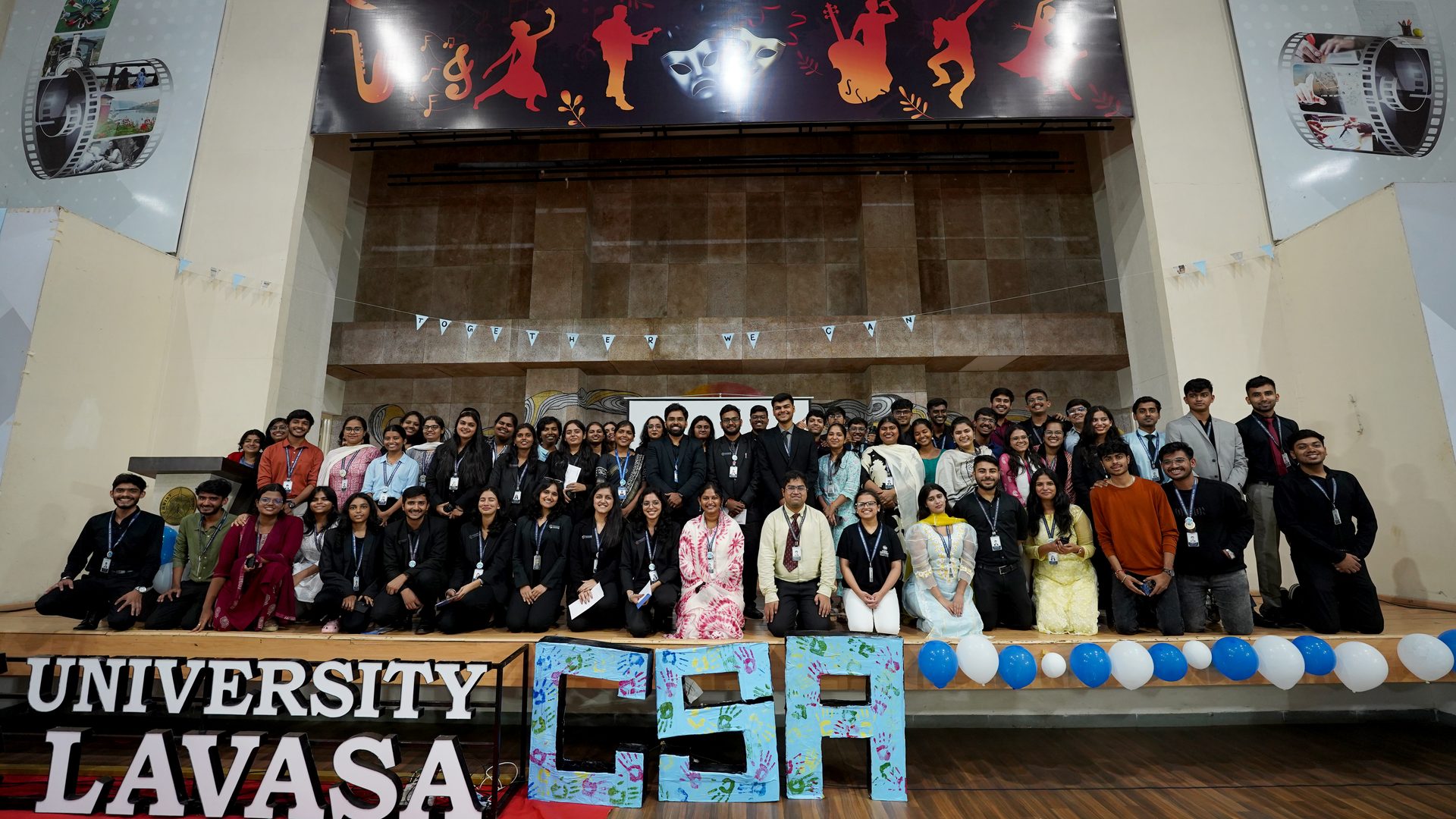
Centre for Social Action · Est. 1999
A platform for students to work with the community, and to develop a sense of social responsibility beyond academics.
scroll downThe Centre for Social Action (CSA) started in 1999 with the vision of providing a platform for students to work with the community. It helped empower underprivileged communities and involved students in social issues, acquainting them with the real world outside academics and inculcating a sense of social responsibility — eventually establishing college–community connections that set up a social lab.
The activities of the Centre create a deep sense of social responsibility among students as they closely interact with children, women and underprivileged communities at large. Volunteers initiate development-oriented plans based on the needs of the community, and grow personally, intellectually and professionally along the way.
Our Goal
To build a community of compassionate students who will seek to improve society.
CSA In Numbers
Our Responsibilities
CSA is the development arm of CHRIST (Deemed to be University), founded in 1999 to organise social awareness programmes for students and to carry out community development initiatives for underprivileged areas.
A movement for a more compassionate and equitable society, with children at the forefront — carried by student volunteers working through six cohorts alongside their studies.
What We Stand For
A better society through sustainable action and social transformation.
Enabling students to become socially responsible citizens through developmental initiatives.
What We Set Out To Do
01
Awareness To enhance awareness among students on social issues.02
Capacity Building To empower students by creating opportunities for holistic skill and capacity development, and involve them in social action.03
Partnerships To collaborate with internal and external partners to fund support for an improved quality of life for underprivileged communities.04
Community Relationships To strengthen University–Community relationships and demonstrate innovative, sustainable human development models.05
Research & Training To provide platforms for research on academic and human development issues, and facilitate capacity-building and training programmes.06
University–Community Connect To help students learn and understand community issues and contribute to the reconstruction of community life, promoting a humane and just society, with children and women as the prime focus for developmental intervention.Where We Come From
CHRIST (Deemed to be University) was born out of the educational vision of St Kuriakose Elias Chavara, an educationist and social reformer of nineteenth-century South India, who founded the Carmelites of Mary Immaculate (CMI) in 1831 — the congregation that administers the University.
CSA believes in empowering the student community to effect constructive social change — one of the driving causes behind its establishment, and still a motivating element for its development initiatives and social sensitisation programmes.
Learners To Leaders
CSA’s Student Volunteerism helps students transform from learners to leaders. Students are engaged through six cohorts, each led by three or four cohort representatives and guided by a mentor, and their initiatives focus on child development and on society as a whole.
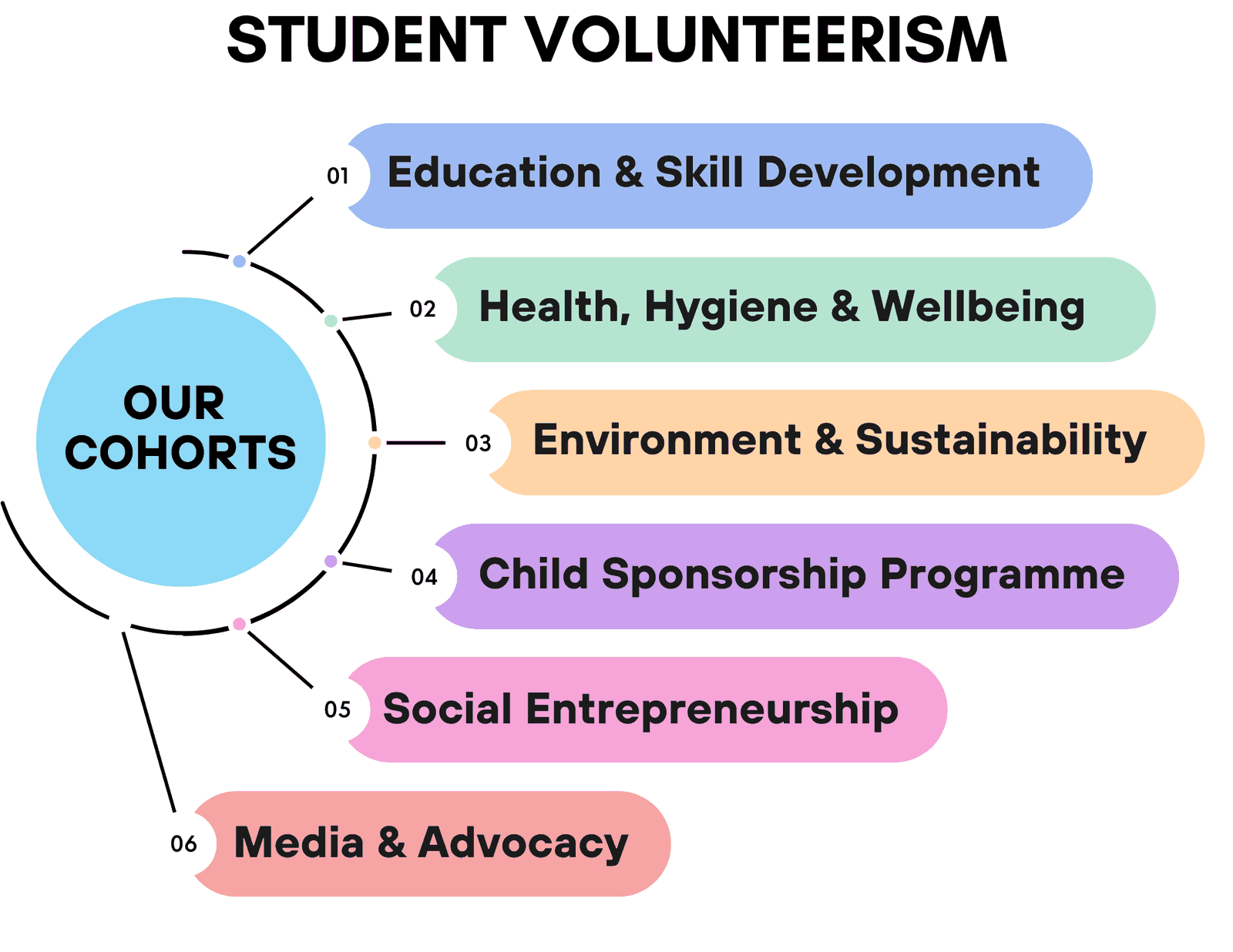
Student Volunteerism
01
Education & Skill Development Learn. Ignite. Discover. Incentivises education for all through the volunteers’ body and resources, in line with the Right to Education. It focuses on the education of children in the Centre’s adopted project areas and on skill development for dropouts, through training and workshop programmes in soft and hard skills and daily teaching sessions.02
Environment & Sustainability Revive. Resurge. Restore. Fosters awareness and understanding of environmental issues and sustainability, aligned with UN Sustainable Development Goals 7, 13 and 15, and engages individuals and communities in proactive steps towards a sustainable future.03
Health, Hygiene & Wellbeing Care. Nurture. Support. Works for the development and accessibility of healthcare across communities, sensitising them on health education and clean habits, in line with the Ayushman Bharat initiative and UN SDGs 1, 2, 3 and 11.04
Media & Advocacy Create. Express. Reform. Looks after CSA’s media, documentation and communication, and sensitises through digital, theatrical and non-theatrical modes. Its Drishti wing performs street plays, stage plays and mimes on campus, in project areas and across the city; it also produces Sanvaad, the monthly newsletter.05
Child Sponsorship Programme Educate. Empower. Elevate. Carries CHRIST’s flagship ‘Educate a Child’ initiative, through which Christites sponsor the education of underprivileged children in the project areas, working towards UN SDG 4, Quality Education. Members run awareness campaigns and distribute educational and nutritional kits.06
Social Entrepreneurship Initiate. Innovate. Inculcate. Promotes sustainable and inclusive economic growth by building business skills and innovation, equipping students and alumni to manage social enterprises and supporting local entrepreneurs and Self Help Groups, aligned with UN SDGs 8 and 17.Waste To Wealth
Parivarthana, the newest initiative of CSA Lavasa, was established in 2024 on the CHRIST (Deemed to be University) Lavasa campus to transform waste into valuable resources and promote responsible waste management. Its primary objective is to keep the campus zero-waste through recycling and repurposing.
At the core of Parivarthana’s operations are the dedicated women within the unit, supported by student volunteers and the University administration. Together they educate students and faculty on waste management, with a focus on the 3Rs — Reduce, Reuse and Recycle.
The unit’s initiatives include paper recycling, waste segregation and product making, alongside educational activities such as awareness rallies and eco-conservation programmes that empower communities and promote sustainability.


Through The Year
The Centre for Social Action was inaugurated at the Pune Lavasa Campus, with the ceremony opening in the traditional way with the lighting of the lamp.
Photo Albums
 Plastic Waste Awareness & Recycle · 17 February 2026
 Plastic Waste Awareness & Recycle · 17 February 2026
 Young Minds Speak · 27 February 2026
 National Science Day · 28 February 2026
 2nd Anniversary Celebration of Sakhee · 06 February 2026
 Idea to Impact – Lessons from Building a Woman-Led Enterprise with Social Impact · 06 February 2026
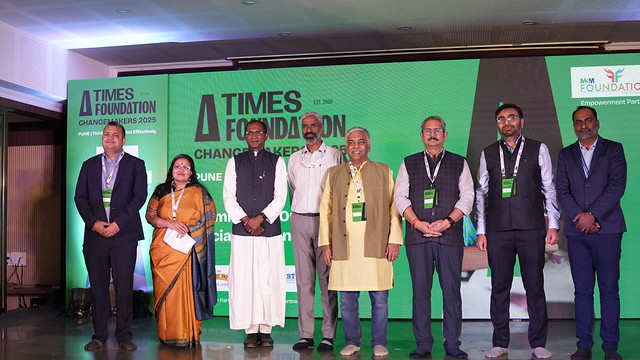 Times Foundation CSR Roundtable Conference · 07 January 2026
 Children’s Day Celebration · 14 November 2024
 Nukad Natak · 13 October 2025
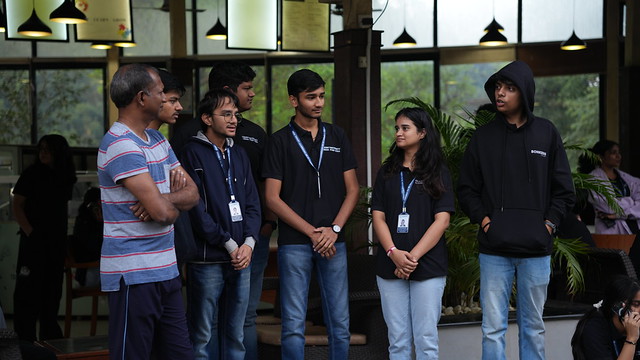 Cleanup Drive 2025
 Badge distribution ceremony of CSA · 1 October 2025
 Health, Hygiene and Well Being Cohort by Dr Sania Siddiqui · 20 &21 September 2025
 CSA Inauguration · 12 September 2025
 Entrepreneurship & Social Innovation · 23 August 2025
 Workshop on Organic Soap Making · 23 August 2025
 Let’s Share 2.0 · 21 August 2025
 MKCL Certificate Distribution · 27 June 2025
 Joy of Sharing · 20 June 2025
 CSA Valedictory’25 · 8 May 2025
 Safai Mahotsav · 23 November 2024
 Children’s Day Celebration · 14 November 2024
 Health & Hygiene Rally · 14 November 2024
 Parivarthana · 24 September 2024
 CSA Inauguration · 5 September 2024
 Mother’s Day Celebration · 11 May 2024
 Blood Donation Camp · 26 April 2024
 7th CSA Diya Stall
 CSA INAUGURATION 2022
 CSA- PROJECT BRIDGE’ 21
 CSA Cleanliness Drive
The People Behind It

Join Us
CSA’s work is carried by student volunteers across its six cohorts, and led by student leaders selected every year.
How CSA Is Led
Why It’s Worth It
Sanvaad
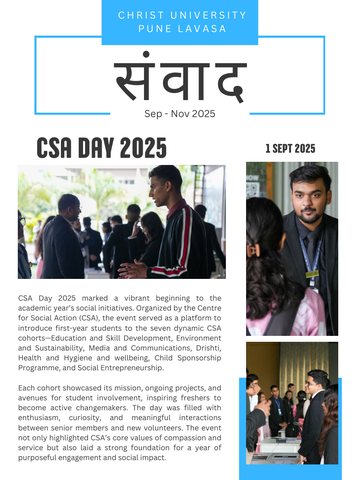
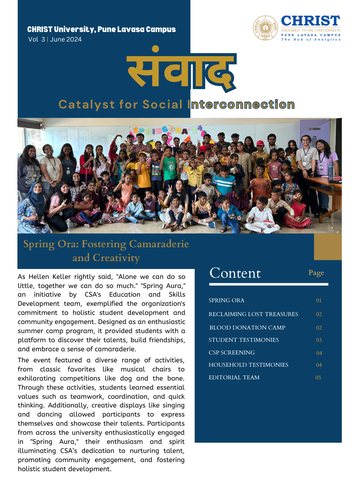
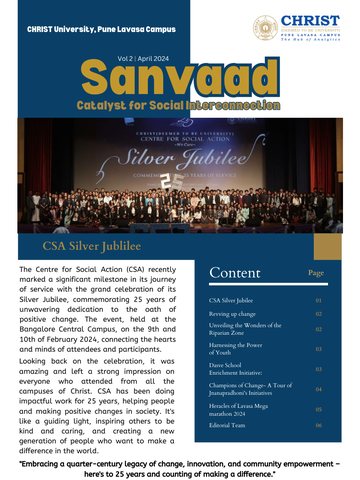
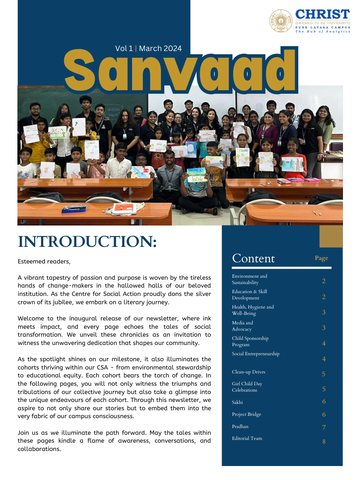
Sanvaad — the catalyst of social change — is the monthly newsletter of CSA Lavasa Campus, reporting the activities CSA Lavasa conducted in the previous month.
Latest Edition · Sep–Nov 2025
Give Back
‘Educate a Child’ is CSA’s flagship donation programme, through which students, faculty and alumni of CHRIST sponsor the education of underprivileged children from villages around Lavasa. It began in 1999 at the Bangalore Central Campus with 50 children from an urban slum community, and has grown to support as many as 800 children a year. In 2023–24, the Lavasa student and faculty community sponsored 40 children from 4 villages.
Pay by cash, or write to csa.lavasa@christuniversity.in and csa.office@christuniversity.in.
Get In Touch
Centre for Social Action · Mail ID
csa.lavasa@christuniversity.inFor queries about the Centre, its cohorts and its work.
Pages
Loading the document
The document viewer needs JavaScript. Read the document using the links below.
Scroll to read - pinch or use the zoom controls to look closer
Centre for Social Action · Est. 1999
A platform for students to work with the community, and to develop a sense of social responsibility beyond academics.
scroll downThe Centre for Social Action (CSA) started in 1999 with the vision of providing a platform for students to work with the community. It helped empower underprivileged communities and involved students in social issues, acquainting them with the real world outside academics and inculcating a sense of social responsibility — eventually establishing college–community connections that set up a social lab.
The activities of the Centre create a deep sense of social responsibility among students as they closely interact with children, women and underprivileged communities at large. Volunteers initiate development-oriented plans based on the needs of the community, and grow personally, intellectually and professionally along the way.
Our Goal
To build a community of compassionate students who will seek to improve society.
CSA In Numbers
Our Responsibilities
CSA is the development arm of CHRIST (Deemed to be University), founded in 1999 to organise social awareness programmes for students and to carry out community development initiatives for underprivileged areas.
A movement for a more compassionate and equitable society, with children at the forefront — carried by student volunteers working through six cohorts alongside their studies.
What We Stand For
A better society through sustainable action and social transformation.
Enabling students to become socially responsible citizens through developmental initiatives.
What We Set Out To Do
01
Awareness To enhance awareness among students on social issues.02
Capacity Building To empower students by creating opportunities for holistic skill and capacity development, and involve them in social action.03
Partnerships To collaborate with internal and external partners to fund support for an improved quality of life for underprivileged communities.04
Community Relationships To strengthen University–Community relationships and demonstrate innovative, sustainable human development models.05
Research & Training To provide platforms for research on academic and human development issues, and facilitate capacity-building and training programmes.06
University–Community Connect To help students learn and understand community issues and contribute to the reconstruction of community life, promoting a humane and just society, with children and women as the prime focus for developmental intervention.Where We Come From
CHRIST (Deemed to be University) was born out of the educational vision of St Kuriakose Elias Chavara, an educationist and social reformer of nineteenth-century South India, who founded the Carmelites of Mary Immaculate (CMI) in 1831 — the congregation that administers the University.
CSA believes in empowering the student community to effect constructive social change — one of the driving causes behind its establishment, and still a motivating element for its development initiatives and social sensitisation programmes.
Learners To Leaders
CSA’s Student Volunteerism helps students transform from learners to leaders. Students are engaged through six cohorts, each led by three or four cohort representatives and guided by a mentor, and their initiatives focus on child development and on society as a whole.
Student Volunteerism
01
Education & Skill Development Learn. Ignite. Discover. Incentivises education for all through the volunteers’ body and resources, in line with the Right to Education. It focuses on the education of children in the Centre’s adopted project areas and on skill development for dropouts, through training and workshop programmes in soft and hard skills and daily teaching sessions.02
Environment & Sustainability Revive. Resurge. Restore. Fosters awareness and understanding of environmental issues and sustainability, aligned with UN Sustainable Development Goals 7, 13 and 15, and engages individuals and communities in proactive steps towards a sustainable future.03
Health, Hygiene & Wellbeing Care. Nurture. Support. Works for the development and accessibility of healthcare across communities, sensitising them on health education and clean habits, in line with the Ayushman Bharat initiative and UN SDGs 1, 2, 3 and 11.04
Media & Advocacy Create. Express. Reform. Looks after CSA’s media, documentation and communication, and sensitises through digital, theatrical and non-theatrical modes. Its Drishti wing performs street plays, stage plays and mimes on campus, in project areas and across the city; it also produces Sanvaad, the monthly newsletter.05
Child Sponsorship Programme Educate. Empower. Elevate. Carries CHRIST’s flagship ‘Educate a Child’ initiative, through which Christites sponsor the education of underprivileged children in the project areas, working towards UN SDG 4, Quality Education. Members run awareness campaigns and distribute educational and nutritional kits.06
Social Entrepreneurship Initiate. Innovate. Inculcate. Promotes sustainable and inclusive economic growth by building business skills and innovation, equipping students and alumni to manage social enterprises and supporting local entrepreneurs and Self Help Groups, aligned with UN SDGs 8 and 17.Waste To Wealth
Parivarthana, the newest initiative of CSA Lavasa, was established in 2024 on the CHRIST (Deemed to be University) Lavasa campus to transform waste into valuable resources and promote responsible waste management. Its primary objective is to keep the campus zero-waste through recycling and repurposing.
At the core of Parivarthana’s operations are the dedicated women within the unit, supported by student volunteers and the University administration. Together they educate students and faculty on waste management, with a focus on the 3Rs — Reduce, Reuse and Recycle.
The unit’s initiatives include paper recycling, waste segregation and product making, alongside educational activities such as awareness rallies and eco-conservation programmes that empower communities and promote sustainability.
Through The Year
The Centre for Social Action was inaugurated at the Pune Lavasa Campus, with the ceremony opening in the traditional way with the lighting of the lamp.
Photo Albums
Plastic Waste Awareness & Recycle · 17 February 2026 Plastic Waste Awareness & Recycle · 17 February 2026 Young Minds Speak · 27 February 2026 National Science Day · 28 February 2026 2nd Anniversary Celebration of Sakhee · 06 February 2026 Idea to Impact – Lessons from Building a Woman-Led Enterprise with Social Impact · 06 February 2026 Times Foundation CSR Roundtable Conference · 07 January 2026 Children’s Day Celebration · 14 November 2024 Nukad Natak · 13 October 2025 Cleanup Drive 2025 Badge distribution ceremony of CSA · 1 October 2025 Health, Hygiene and Well Being Cohort by Dr Sania Siddiqui · 20 &21 September 2025 CSA Inauguration · 12 September 2025 Entrepreneurship & Social Innovation · 23 August 2025 Workshop on Organic Soap Making · 23 August 2025 Let’s Share 2.0 · 21 August 2025 MKCL Certificate Distribution · 27 June 2025 Joy of Sharing · 20 June 2025 CSA Valedictory’25 · 8 May 2025 Safai Mahotsav · 23 November 2024 Children’s Day Celebration · 14 November 2024 Health & Hygiene Rally · 14 November 2024 Parivarthana · 24 September 2024 CSA Inauguration · 5 September 2024 Mother’s Day Celebration · 11 May 2024 Blood Donation Camp · 26 April 2024 7th CSA Diya Stall CSA INAUGURATION 2022 CSA- PROJECT BRIDGE’ 21 CSA Cleanliness Drive The People Behind It
Join Us
CSA’s work is carried by student volunteers across its six cohorts, and led by student leaders selected every year.
How CSA Is Led
Why It’s Worth It
Sanvaad
Sanvaad — the catalyst of social change — is the monthly newsletter of CSA Lavasa Campus, reporting the activities CSA Lavasa conducted in the previous month.
Latest Edition · Sep–Nov 2025
Give Back
‘Educate a Child’ is CSA’s flagship donation programme, through which students, faculty and alumni of CHRIST sponsor the education of underprivileged children from villages around Lavasa. It began in 1999 at the Bangalore Central Campus with 50 children from an urban slum community, and has grown to support as many as 800 children a year. In 2023–24, the Lavasa student and faculty community sponsored 40 children from 4 villages.
Pay by cash, or write to csa.lavasa@christuniversity.in and csa.office@christuniversity.in.
Get In Touch
Centre for Social Action · Mail ID
csa.lavasa@christuniversity.inFor queries about the Centre, its cohorts and its work.
Pages
Loading the document
The document viewer needs JavaScript. Read the document using the links below.
Scroll to read - pinch or use the zoom controls to look closer